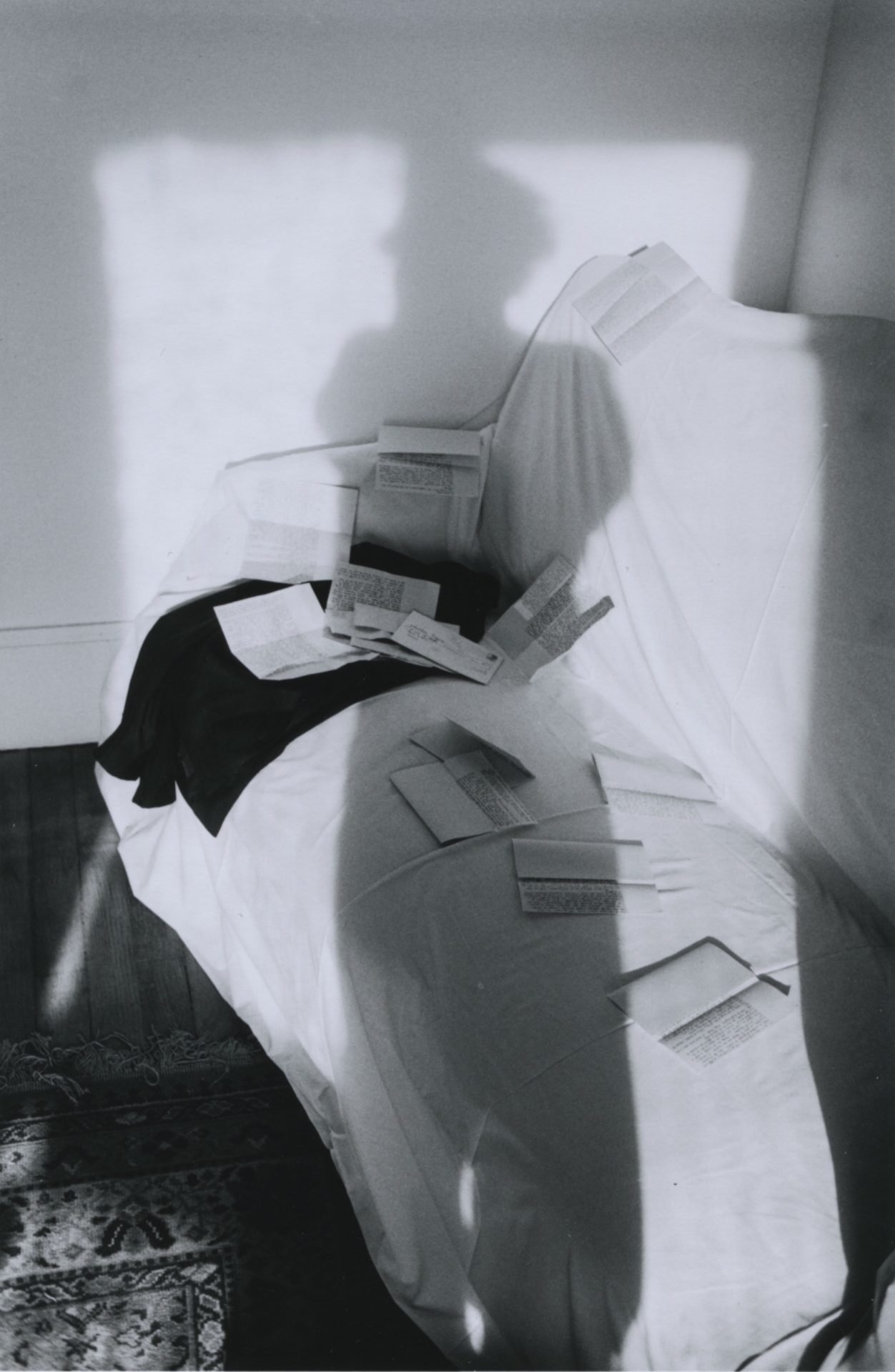
“We are doomed historically to history, to the patient construction of discourses about discourses, and to the task of hearing what has already been said,” wrote Michel Foucault in The Birth of the Clinic. He was making the methodological point that we are always immersed in the knowledge and terms that precede us, that the language we inherit to comment on the world has already shaped how we will comment. But his contention could double as a description of what it’s like to relate to someone with dementia.
“I know I’ve asked you this before,” my mother often says to me these days. “But where do you live?” New York, I tell her. “I wonder why I can’t remember that,” Mom responds. Because you’re having some memory problems, I advise her. She can’t remember that either. I try to be patient, as Foucault advised. Unlike Foucault, I’m not a student of discourse, and unlike my mother, I’m not a student of history. But one way to remain with my mother is to become a historian of her, and to do so is to submerge myself in her discourses about discourses: medical discourses, sexual discourses, family discourses, diet discourses. It is also to hear what has already been said, or in my case to read what has already been written, in the journals that my mother has kept since 1975.
For years, Mom’s ever-growing collection of private volumes dwelled in her study, wedged between her extensive Foucault collection and her stand of books on 19th-century French sanitation. As my mother’s memory has faltered and then departed, I have returned often to a conversation we once had about these journals, my historian mother’s own archive. “Do you want me to redact the sex scenes?” she asked me over the phone one unremarkable afternoon in 2018. “I could just blot them out with a marker,” she added, before warning me that “these will be yours one day and some of this stuff is pretty racy.” I responded agnostically about the prospect of scrubbing her erotic life; aren’t we all pornographic in our own way? The main thing, I said, was that I’d rather read about her life with her than have to stumble through her thoroughly illegible handwriting — a mix of print, cursive, and what might as well be Cyrillic — with a flashlight and magnifying glass after she passes. The sex scenes remain, as does my mother, who is very much alive. Yet here I sit, with her forty journals spread over just as many years, reading and writing her life without her.
She was prolific in the late 1970s, as she transformed herself from a Southern belle whose favorite book was Gone with the Wind into a polyglot PhD who could quote Albert Camus off the cuff. She wrote most months of the 1990s and the early aughts, as she secured a tenure-track job, published a book, delighted in the study of medical history and in the fact that her children had become somewhat self-sufficient. There is less of a record of the 1980s, a time, it appears, of professional despair and the deep personal ambivalence that is unique to child-rearing. The 2020s will form her own lost decade; she’s been simultaneously present and not. But throughout all the journals, intimate crises — affairs, divorce, a slew of births and deaths — offered occasions for open and searching prose. Birthdays urged annual accounting both moral and fiscal. Above all, and ironically for a Foucauldian—or perhaps appropriately, depending on how one reads him — Mom’s journals were a vehicle for the disciplining of herself, particularly around the subject of her weight; for the keeping of her sexual secrets; and for her ruminations on the deviant sexualities around her — mine, for example.
I have known of Mom’s journals forever. On car trips through the American South, as my father drove and she navigated from the passenger seat, they often rested on her lap. On transatlantic flights, after she’d had a glass of sauvignon blanc to calm her nerves, one would emerge from her bag. When she waited to retrieve me from tennis practice, I frequently saw her jotting in them. As young adults, whenever my sister or I felt pained or bewildered, whenever we encountered the personal or professional obstacles life is so famous for putting in one’s way, Mom’s advice to us was the same: “Keep a journal.” Would a biologist mother, an interior decorator mother, a lawyer mother have offered different counsel? Probably, but my own mother was (is?) a historian of French public health who spent her days in archives and libraries, and if her daughters were going to suffer, she believed they should have a record of it.
I’d previewed her private archive long ago. Any academic is only as good as their canvas tote bag of books, and often, in high school, waiting in the car while she ran errands, I would blindly submerge my hand into my mother’s portable library and retrieve, say, Galileo: Heretic or the slim but enlightening Fighting the Plague in Seventeenth-Century Italy. What strange, impromptu study sessions — the only ones I really engaged in as a teenager. They made me an unintentional repository of Mom’s academic research, one who could be counted on to list the four humors in a game of Trivial Pursuit, and with whom Mom could joke about tools of historical dentistry or bloodletting practices through the centuries. Maybe I’d read a page before she returned, maybe I would make it halfway through the introduction — it depended on the errand. And so one day, languishing in the parking lot of a Food Lion in Blacksburg, Virginia, I reached for a book.
The black volume I pulled out wasn’t printed but handwritten, because it wasn’t a book but a journal. Before I snapped it shut, I read only one sentence. Out of several hundreds of pages and tens of thousands of lines of idiosyncratic script, the one that gathered my focus had the visibility of giant geometric crop circles as seen from an airplane.
“Marshall and I are having an affair.”
I read that line — suddenly, awkwardly, accidentally — on a low-humidity Sunday afternoon in late August 1991. Adolescent summer’s aimlessness I found depressing; the approaching new school year, with its demands and structure, often rendered me resentful. I’d spent the early part of the day listening to Pink Floyd’s 1987 album A Momentary Lapse of Reason, a post-psychedelic collection whose title and cover — rows of asylum-style beds on a beach, one occupied by a distressed and perhaps psychotic man doubled over, likely in pain, with his head between his knees — now seemed like a haunting prognostication. My mother had popped into the supermarket for a quart of buttermilk. Such details remain sutured to my memory, like the view from the car’s passenger seat, the lack of landscaping around the parking lot, and the green-and-white street signs of our modest 1970s-built subdivision, each one carrying the name of a slaveholding president’s plantation.
In retrospect, I can see how conceptually adrift I was, how poorly seventh grade had prepared me for poststructuralism.
Tweet
My senses heightened and constricted simultaneously. A sort of existential nausea grabbed me. My small world transformed. Before Mom’s unintended announcement, I had been a teenager in search of a crisis, a proto-depressive pubescent just waiting for an exterior event to validate my interior state. Now I had one, just not the one I wanted.
“Do you ever write fiction?” I managed to ask Mom that evening at dinner, a meal I couldn’t bring myself to eat because of the questions now churning inside me. Was Marshall a character Mom had invented? (No.) Or my parents’ colleague, the one who sometimes came over for dinner with his wife? (Yes.) Would my parents divorce? (Yes.) What did my father know? (Quite a bit, actually.) Could it be that my family’s fate now lay with my ability to keep a sexual secret? (No, but I believed it did.)
“Never. I don’t have a creative bone in my body,” she answered swiftly. “Not like you—you’re the creative writer.”
Recently I found some evidence of my “creative writing” in one of Mom’s journals from around this time. My mother always sent out an earnest holiday letter, featuring an annual chronicle of good times enjoyed and bad times weathered. So reliable and generic were these epistles that, by high school, I had begun to issue my own renditions of them, fond parodies of my mother’s prose. I’m not surprised she saved them; she was my audience and my muse. One, from 1990, is composed in Seussian couplets, and contains what I believe is my first written reference to Michel Foucault:
Every citizen who lived in Blacksburg liked Christmas a lot,
But Ann, who lived on Mount Vernon Lane, did not .
Ann hated Christmas, the whole capitalist season,
Please don’t ask why, you don’t want the reason.
“They’re playing Barbra Streisand,” Ann snarled with a sneer
“Christmas is coming, it’s practically here.”
Then she fingered through her books of Foucault
And said, “I must deconstruct Christmas, so all will know
“That no matter the holiday, Christmas or Easter,
I’ll not spend a penny, I’ll remain meager.”
It was true that Mom, in the years just before the end of her marriage to my father, became a serious disciple of Foucault. By the time he died in 1984, Foucault had become perhaps the most famous philosopher in the world, an intellectual celebrity whose translated works were beginning to transform American humanities and social sciences. Mom had been trained as a social historian in the early 1970s. Her research was modeled on stolid, scrupulously periodized books with titles like Working and Wounded: Women Weavers in Lyon, 1819–1832 or Sick and Starving: Poor Patients in Paris, 1837–1852. Then Foucault arrived with his centuries-spanning philosophical histories of sexuality, insanity, prisons, and clinics. His work and his life possessed drama and style. Mom’s work possessed neither, while her life possessed a style but not yet a drama. Reading Foucault would change that.
Foucault’s books proliferated around our house. Discipline and Punish; The Archaeology of Knowledge; Madness and Civilization; The Order of Things; Naissance de la clinique — a special one for Mom, whose first book was a history of French medicine, 1802–1834. Foucault too had spent his early academic years in medical archives. But more than disciplinary interests, he and Mom shared a mutual skepticism of liberal historiography: History doesn’t get better; things just change. His tomes appeared in my mother’s menagerie of tote bags and on the table before we cleared it for dinner; I have a photo of her reading Discipline and Punish lying atop a bed, in a dowdy L. L. Bean fleece, with a sleeping cat on either side of her and snow falling outside the window. “Foucault would say . . .” might come out during a dinner conversation. “Well, as Foucault argued,” I’d hear her mention to a colleague. An errant draft, left in the printer, of the final exam for her senior seminar posed the essay question, “According to Michel Foucault, what is the chief difference between ars erotica and scientia sexualis?”
Foucault entered my life, too.
My first memory of him was an innocuous interaction, a chance encounter that passed me by, but which has since assumed an outsize proportion in my own intellectual genealogy. By age 13, I had stopped growing and was destined, it seemed, to have feet larger than average for my height. “But why average something?” Mom casually asked while I was trying on new tennis shoes one summer afternoon in a Foot Locker. “Average height? Average weight? Average foot size? What kind of knowledge is that?”
“To know what’s in the middle,” I replied. In retrospect, I can see how conceptually adrift I was, how poorly seventh grade had prepared me for poststructuralism. “But why is it meaningful to know what’s ‘in the middle’?” Mom returned. “There was no ‘middle’ in the 18th century,” she concluded, as I selected my new shoes. She didn’t use Foucault’s name, but the inquiry had all the markings of the man who had become her teacher. Gently, and without success, Mom nudged me to consider the social context of early modernity, capitalist democracy’s rupture into the long present, the flattening effects of an emergent wage-labor structure — all of which form Foucault’s methodological opening, his launchpad into a world of freedom and regulation, deviation and desire. Averages make sense to so many of us who are average . But what kind of style, creativity, difference, and freedom does a society forfeit in an era of averages?
The summer after I read the journal, my parents decided Mom and I would travel to Paris together. I was doing poorly in high school; their marriage, unbeknownst to me, was nearing its conclusion; and in any case, Mom needed to visit the archives.
For years we had taken these summer sojourns as a family. Every day Mom would depart for the Bibliothèque Nationale de France or the Archives de l’Assistance Publique–Hôpitaux de Paris while Dad ferried my sister and me around the carousels and crêperies of the Luxembourg Garden. “Paris every summer, wow,” teachers and camp counselors would say when I told them about my family’s far-flung itinerary. The glitz of the Champs-Élysées, they’d imagine, the multiple stories of haute couture shopping at the Galeries Lafayette. “We stay on the Left Bank,” I’d explain, “near the Collège de France. Foucault had a chair there.” “Oh,” invariably came the bewildered response. Who knew who Foucault was? Who knew why he had a chair? I have memories of the four of us lunching at Café de Flore, my sister and me overwhelmed by jet lag, heads on the table, while my mother explained to us that Jean-Paul Sartre and Simone de Beauvoir had dined there.
But now Mom and I were in Paris alone. Or rather, we were in Paris with Michel Foucault. Mom had started a new book on the history of French microscopy, on how French physicians did or didn’t adopt the microscope in the mid-19th century and what they did or didn’t see. The research had prompted her to take up one of Foucault’s idioms — what he called “the medical gaze.” Late 18th-century French medicine offered, he said, “the fact of being constantly seen, of being able always to be seen that maintains the disciplined individual in his subjection.” Microscopy for Mom concerned sight, but also control, power, and discipline.
The book was provisionally titled Refocusing the Microscope: Medical Microscopy at the Paris School. “But in what sense are we refocusing?” the introduction asked. Reading the old drafts now, I see that Mom herself was also refocusing. She was refocusing on her research after years of child-rearing. She was focusing on her affair with Marshall. And for Mom, as for Foucault, the professional and personal went together. “Someone who is a writer is not simply doing his work in his books,” Foucault believed. “The private life of an individual, his sexual preference, and his work are interrelated, not because his work translates his sexual life, but because the work includes the whole life as well as the text.” In fact, my mother’s relationship with Marshall was her second extramarital affair, a history I didn’t know then but do now. In the journal she devoted to that previous dalliance, she quotes Foucault as a kind of epigraph: “To work is to undertake to think something other than what one has thought before,” Mom transcribed in French. Writing a book is work, and so is leaving a marriage.
To turn my own focus toward this research today is a melancholy exercise. Mom’s still here. I can call her and talk to her, though not about French medical history. Not about anything, really — we mostly exchange affective states and appreciate the fact of each other’s being. Of the growing collection of losses I feel so acutely in the wake of Mom’s dementia, many are the obvious and expected. Her whole self. Her role as parent. Her daily phone calls to me. Other losses I am genuinely surprised by. The strangely reassuring experience of her bourgeois propriety, for one. And her toiling away in the medical archives, for another.
During our mother-daughter Parisian summer, we would meet postarchive at cafés, usually over bread or croissants. (These calories Mom would record and later despair about in her journal: “I am fat. Even w/all the walking. Must diet for a few days.”) I’d hear about the characters she was researching: anatomist Paul Broca, bacteriologist Alfred François Donné, and pathologist Xavier Bichat, a medical researcher who refused to use the microscope, since in the “darkness, everyone sees in his own way.” But other memories, nonarchival in nature, dominate. It had been eleven months since I’d read that fateful line in Mom’s journal: “Marshall and I are having an affair.” Through a mix of anger and depression, I’d been able to live an uncertain truth. Marshall was always there, but not. My family existed intact but, as Walter Benjamin had once described Paris’s haut bourgeois monuments, it dwelled in a “state of ruins even before it ha[d] crumbled.” The problem was that sharing a hotel room with my mother threatened the emotional balance I’d been able to maintain in the face of her sexual secret, the one she still did not know I possessed.
Like numerical averages, sexual secrets offer a strange sort of knowledge. Foucault rues the encasing of sex as “an object of secrecy,” which he says forms the chief legacy of “monotonous nights of the Victorian bourgeoisie.” He also contends that everyone knows the secrets: Never, he says, has a society talked so loudly, so much, to so many people, about something it claims is better not discussed, than did the Victorians about sex. I knew Mom was having an affair, but I buried that knowledge. I didn’t realize my parents were already in the process of separating, though I had a feeling of impending doom. Mom, for her part, noted my “moodiness” and wrote in her Paris travel journal that “LCL knows we are separating. I wonder if she knows [Marshall and I] are lovers. She seems to suspect.”
“Her favorite author is Fuk-Yoo. The great French fi-lo-sof, My-Shell Fuk-Yoo.”
Tweet
Each night in Paris, after a perilously carb-heavy dinner, we would return to our little room at the Hôtel Delavigne, where the phone would emit those odd, off-key Continental rings. The sound might as well have been an air-raid siren. “That was my colleague, Marshall,” my mother explained after the first of these long-distance conversations. “Oh,” I said, with a certain disbelief. So Marshall knew we were in Paris. He knew our hotel, and he knew his call would be welcomed. Mom continued, “His grandson is suffering from a terrible depression. They found him in a closet, crying.” “Oh,” I repeated. So Marshall’s grandson’s depression was worthy of acknowledgment and attention, but my yearlong slog of secret-laden fright and despair somehow had attracted little notice. If our hotel room had had a closet — Paris hotel rooms didn’t then and still don’t — I surely would have retreated into it and begun to cry, too.
The next evening the phone rang again, and Mom and I repeated our exercise. “That was my colleague, Marshall,” she said after hanging up. “Oh.” “It’s very hard for parents to watch their children suffer,” she said, and explained to me the necessity of their transatlantic phone calls and of Marshall’s need for support during his family’s moment of crisis. “I thought it was his grandson,” I retorted — the first time I had allowed myself to say anything at all about l’affaire Marshall. I meant to deliver a snide barb, but Mom took it as an opening: “His grandson is having emotional problems. His daughter’s son. But it’s not only his grandson who is suffering—it’s also his daughter.” She had more to say, but I had already departed — not physically, which was impossible in a tiny hotel room that lacked even a shower curtain, but emotionally.
On weekends, when the archives were closed, Mom and I roamed Paris. We visited places I knew well, like the École Normale Supérieure and the Panthéon, and places I didn’t, like the Musée Picasso. I had felt the presence of Foucault on our France trips before, but now I felt the presence of Mom’s lover as well. “Marshall loves Picasso. He teaches a visual cultures class,” Mom offered as we sat in that museum’s café. At the Shakespeare and Company bookstore, Mom mentioned that Marshall had a collection of more than five thousand books and that he planned to open a used bookstore after he retired. “Oh.” Then, each evening, back to the claustrophobic hotel room. When would the phone ring? How long would they speak? How would the event be explained?
The anxiety meant that I could no longer feel much fondness for Paris, which I had once delighted in, principally for its leash-trained cats and for the sheer difference it offered from Appalachian Virginia. At a screening of the new Merchant Ivory film, Howards End, I felt saddened while my mother laughed. At the Musée d’Orsay, I failed to be impressed by the Impressionists. I declined a trip to Chartres, and at Notre-Dame I lit a candle for myself. Mom’s travel journal captures my reticence, if not its source. “LCL being a bit of a pill,” she notes. “Moody teenager, I suppose.” She seemed to realize we had become somewhat distant from each other the preceding year, and she sought to rectify our posture. “With LCL here I’m not spending as much time in the archives, but this bonding with her is important.” Even so, our interests differed. I wanted to spend time at Jim Morrison’s grave in the Père Lachaise cemetery, and Mom wanted to take in a textile exhibit at the Musée de Cluny. We did both, each trying to accommodate the other. “I loved the unicorn tapestries,” Mom recorded of our afternoon at the museum, “but LCL not impressed. She’s not one of those teenagers who are awed by the Middle Ages.”
One evening, as the mosquitoes swirled through our hot hotel room and Mom talked to Marshall in a performatively hushed tone, I reached across the small expanse of our shared bed and turned on the television. My goal was to emit a volume loud enough to drown out her voice and perhaps force her to terminate her call. With only three channels to choose from, I selected the most violent: a nature documentary about Inuit whale hunting off the coast of Greenland. Its scenes included roiling images of slaughtered whales and a sea discolored by blood and blubber. The monotone voice-over from a French David Attenborough equivalent announced:
Ces baleines sont mortes. Leurs frères seront également massacrés.
[These whales are dead. Their brothers will be killed, too.]
I was transfixed — the pain of the whales was so palpable, I felt as though I were one. In a way, I was: a large mammal afloat in a cold sea, surrounded by spears and harpoons. I had hoped the whales’ pain would affect my mother, but it was I who began to cry.
My cries turned to sobs, then hysterics, then heaves. I disgorged a year’s worth of tears. The number and decibels of my shrieks, between jagged efforts at breath, were enough to orient my mother away from Marshall’s travails. She inquired into what was the matter, and examined me as she might an archival find, initially cautious, then more exploratory.
Those tears carried my secret’s excess baggage, its concomitant pain as well as my mother’s indifference to it all. Even had I not been hysterical, I likely couldn’t have answered the question, What is wrong? (Not that she had asked). But now that I was hysterical, and now that she had asked, I definitely couldn’t answer. I could barely compose a sentence. Still, I felt compelled to explain my total and seemingly inexplicable breakdown, my momentary lapse of reason. “Look at those whales!” I screamed. “It’s awful to be a vegetarian in Paris. Could we for once go to a country that isn’t so fucking obsessed with steak?”
Soon after, back stateside, my parents informed my sister and me of their imminent separation. And a few days later, my dad moved out, and Marshall arrived.
It wasn’t long before I had a sexual secret of my own to divulge. I would be accompanied by a familiar French figure. Just before I left for college, Mom supplied me with a recently published book, David Macey’s The Lives of Michel Foucault. She had both the hardcover and paperback and imparted the former to me, inscribing my name in it. It was one of the few books I had in my possession in those first months at school — I can also recall a Roget’s Thesaurus, On the Road, and the E. D. Hirsch–edited Dictionary of Cultural Literacy, all serendipitously positioned on my dorm-room bookshelf and on the threshold between the anxious boredom of adolescence and the emergence of an adult interior life. But I’d already read On the Road — twice, actually. And my two other books had an encyclopedic quality that discouraged sustained attention. Thus: The Lives of Michel Foucault. One day I began to read. Mon Dieu! What a life, what lives, Foucault led. I was enraptured, I was seduced, and, a couple of chapters in, I had become a little disturbed as well.
To call my response to this book narcissistic would be to underestimate the seductive power of the reflecting pool into which Narcissus gazed. I read of Michel Foucault, and I thought not of his philosophy with its attention to language and category, not of the critique he leveled at modernity — that it was a tangle of overlapping prisonlike structures, each one first providing and then sucking the life force out of every adult and child — not of Paris, not of France, not even of my mother. No, I thought of myself. I was awestruck at the intellectual poverty of my own mind, a place I now realized was composed of one barren pasture after the next. Reading an article in the New Yorker I considered a major intellectual feat; philosophy, I believed, consisted of contemplating Pixies lyrics, ideally stoned.
I was 19.
By that age, Foucault was residing in an unheated room on Paris’s Left Bank, in Saint-Germain-des-Prés, where, under several layers of blankets, he studied for his admission to the elite École Normale Supérieure. I knew the neighborhood well; it was where we stayed during Mom’s various archival sojourns. I could picture him, shuttered away in a dingy little chambre, probably with baguettes everywhere, reading. And reading. And more reading. According to his biographer, Foucault made “rapid progress in philosophy, as well as in history, Greek and Latin.” He excelled in German, too. “In the absence of translations, Foucault was obliged to tackle Heidegger in the original [language].” How did he do so much at such a young age, any reader, including this one, quickly begins to wonder. As if anticipating this very question, Macey writes: “Everyone agrees that the young Foucault had a remarkable capacity for work, that he made notes on everything and stored them neatly in boxes.”
Everyone also agreed that I had no such scholarly commitment. But The Lives of Michel Foucault accomplished what so many strolls down the Boulevard Saint-Germain had not. I followed Mom and turned toward French intellectual history. It was a wrong turn — I ultimately exited onto the Einbahnstrasse of German intellectual history right next door. But Mom steered me toward the Continent in philosophical form, and during that first year of college, I gradually became what I had never been in high school, what I had never been before in life: a student, with Michel Foucault my guiding star. I knew that I couldn’t think as Foucault did, but perhaps I could think about him. If I couldn’t study history as Foucault had, maybe I could study him.
Men placing their heads on each other’s shoulders. Men kissing hello and then kissing goodbye. From my mother’s vantage we might as well have been in a back room at the Ramrod.
Tweet
I did not realize he was gay. Nor did I realize I was gay. Or, rather, I did realize he was gay, but I didn’t allow myself to consider the full implications of his gayness, since they might have seeped into other necessary considerations, like those of my gayness. Still, telltale signs, like the girlfriend with whom I spent much of the academic year in bed, emerged. She had transferred to my despairing liberal arts school from another despairing liberal arts school, where she had studied ancient Greek. “Just like Foucault!” I exclaimed when I learned this. “I can read Latin,” I lied. Perhaps our poorly insulated cinder-block dorm room at Hampshire College could be a stateside offshoot of the École Normale Supérieure.
With her and a handful of others, I formed a fledgling Foucault reading group. We only met once, and many of us had failed to complete our modest assignment, which was to read the introduction to Discipline and Punish as well as its sadism-themed first section, “Torture.” One of Foucault’s most influential texts, Discipline and Punish traces the historical substitution of a regime of spectacular physical punishment for a state apparatus of scientific control and surveillance. (Mom loved the book, which she read, rather against the grain, as a kind of how-to guide. If a whole society could be disciplined, perhaps she could discipline herself to shed a few pounds on her various “diet regimes.”) Our middling reading group didn’t get that far; we made it only to the grotesque opening scene of a would-be regicide getting drawn and quartered. Still, I felt empowered to have bought my own copy of the book — subtitled The Birth of the Prison — and I considered the group a success. In addition to reading about Foucault, I showed the world, or at least four friends, my girlfriend, my own self, and my mother, that I could read Foucault, that Mom and I could be amies philosophes.
As I read more about Foucault, I became drawn to his later work, his later life, in which he moves away from modernity’s various constrictions and toward the pursuit of a queer living practice, one in which philosophy and same-sex desire were conjoined and reflexive. “To be ‘gay,’ I think, is not to identify with the psychological traits and the visible masks of the homosexual but to try to define and develop a way of life,” Foucault explained. That was my new project: a Foucauldian enterprise, a “philosophy-as-life.”
I imagined that together Mom and I would celebrate. “Mom’s a Foucauldian,” I explained to the girlfriend. “She’s the one who told me that sexuality is socially constructed. They didn’t even have homosexuals in the 19th century.”
Instead, when I told Mom I was in a relationship with a woman, she began to weep. I was paradigmatically unprepared. I want to think that as she cried that afternoon at Mill Mountain Coffee and Tea she had a fleeting thought: A true Foucauldian wouldn’t render a moral judgment on her child’s sexual practices — gay or straight, vanilla or kink, poly or monogamous — and that somewhere her philosophical tutor was urging her to reconsider. “This work of modifying one’s own thinking . . . seems to me to be the very purpose of intellectuals,” Foucault claimed. It was a phrase that moved Mom so much that she copied it into one of her journals. But that day, after she collected herself, she likened my condition to a chronic illness. “It’s like diabetes or paraplegia,” she told me. “You can live with it, but your life will be unpleasant.” Then she dabbed her tears with a coffee-stained paper napkin and said she had errands.
My mother had been enjoying a new life with her new husband, Marshall: new house, new travels, a renewed commitment to her microscopy book, two new cats and an updated golden retriever. “I am truly blessed,” Mom had journaled the previous year, in a notebook she’d titled — rather creatively — La Vita Nuova. “God has smiled upon me. I have the greatest husband in the world — how I love him!”
Now, in her journal entries, she despaired. “I consider homosexuality a major birth defect,” Mom wrote. Perhaps it was just as well that “homosexuals can’t reproduce [and that] Leigh Claire is an evolutionary dead end.” She worried about how problematic it all was for Marshall, too. “Marshall says he doesn’t like lesbians. Fair enough. But now my daughter says she is one,” Mom journaled. The shame she felt that this was her offering to their vita nuova was profound.
Marshall also didn’t like Foucault. A septuagenarian and an Americanist — he had earned one of the first PhDs ever offered in American studies — Marshall resented my mother’s interest in French history. In fact, he resented that she was the intellectual and he no longer was. “Ann only reads the French,” he regularly ribbed my mother. “Her favorite author is Fuk-Yoo. The great French fi-lo-sof, My-Shell Fuk-Yoo.” Even so, in their new house, the first volume of Foucault’s History of Sexuality was a coffee-table mainstay; I recall using it as a coaster. “I guess that’s what a French philosopher has to write about,” Marshall once quipped. “Sex!” But Mom never seemed bothered by, or even particularly tuned in to, Foucault’s sexuality. I never heard her discuss the fact that her intellectual hero was a habitué of leather bars, well practiced at sadomasochist sex, and considered anal fisting one of the 20th century’s genuinely novel inventions. She knew of Foucault’s many lovers, of his long-term partnership with Daniel Defert. I suspect that she preferred to ignore this aspect of her favorite thinker, an interpretive choice that then limited her knowledge of how crucial his gayness was to his philosophy.
Mom and I entered our own dark age, a period of distance and retreat. We had finally become members of the same team — the family’s two lone intellectuals in a sea of Agatha Christie readers and PBS NewsHour watchers — but our roles began to change as I took the part of homosexual wet blanket and she of heterosexuality’s biggest booster. Far from understanding sexuality as socially constructed, in her journals she returned often to a sense of loss and powerlessness about my queerness: “What can I do?” “She can’t help it.” “It is beyond us all.” By the time I graduated from college, Mom had been grappling with my sexual orientation for years. Despite her shame and disappointment, she really did try. She took my girlfriend and me out to dinner; she invited her to come visit Virginia, and hosted her generously once she got there. She told me the set of family silver she had reserved for me was still mine. I believed her homophobia had plateaued, if not dissipated. But watching me walk across a shoddily constructed stage to receive my undergraduate diploma, she noted in her journal, “Leigh Claire looked so beautiful at her graduation and for a few glorious moments I could imagine that she wasn’t a queer.”
What an odd thing for a Foucauldian to convey, and what an odd philosophical position for Mom to have occupied, that of a homophobic Foucauldian. It’s all too easy to ask: Did Mom fail at Foucault? Maybe. But if she did, then I did, too. Because I had let my life be structured by a sexual secret, one I then tried to liberate myself from by claiming a sexual identity. Foucault insists that these polarities—to be against homosexuality and to identify as a homosexual—are two sides of the same coin, two dead ends in modernity’s trap.
In 2001, Mom was invited to spend a month in Paris and present her microscopy work at the École des Hautes Études en Sciences Sociales. In weekly lectures, she’d present on her book in progress, the one she was having increasing trouble finishing. She hoped that Marshall would accompany her, but he was so anti-French. So Mom invited me.
Once again Mom and I found ourselves strolling the broad boulevards of Paris and wandering down labyrinthine little streets. We happily went to the Musée de Cluny together so I could explore my new interest in medieval economics. We sat in cafés and sauntered through gardens. Our days passed like our Paris days of yore, except that this time, Mom had been given an apartment by her hosts far from the academic Left Bank. Instead we were staying on the tony Right Bank, in the Marais — one of Paris’s chicest locales, and also one of its gayest. The quartier was filled with wallpaper stores and stores that appeared to be wallpaper stores but in fact just had fantastic wallpaper. Its boutiques offered an endless array of objets d’art. Walking the streets of the Marais one noticed the surfeit of urban energy, its easy anonymity, a public suffused with a casual sensuality and sexuality. And it was also a world of men. Men walking arm in arm, hand in hand. Men placing their heads on each other’s shoulders. Men kissing hello and then kissing goodbye. From my mother’s vantage we might as well have been in a back room at the Ramrod.
It was a warm May, and the cafés spilled out onto the sidewalks. Everywhere there were tables of four or five men, some wearing sleeveless shirts; others had earrings or well-groomed facial hair. Mom had long asked me searching questions about my kind — Why do gays do this? Why do lesbians do that? Now she had something new to consider in her ongoing ethnography of homosexual oddities. Why do homosexuals chat with each other at cafés? On a sunny afternoon, some gay men seemed content to delicately sip espressos while others imbibed aperitifs. Sometimes they lingered, apparently enjoying one another’s company and appreciating the urban sensorium.
My mother was appalled.
“They just sort of sit there,” she commented, “in packs.”
“Now, would you say cafés in straight neighborhoods are filled with packs of heterosexuals?” I inquired.
“Oh, stop it, Leigh Claire,” she hushed me. “You know what I mean.”
She meant a lot of things. That she was disappointed to have a queer child. That part of her knew quite well why gay men might enjoy sitting in cafés and talking, seeing and being seen, but that another part of her wished that not only these gay men but gayness itself would disappear, at least for the month she was in Paris. It reminded her too much of the loss she felt with me.
Every familial symptom has its limit, and our homo versus hetero routine was nearing its denouement, just blocks from the site of the eruption, years ago, of the other sexual secret we’d once danced around. “I don’t quite know what you mean, no.”
“Well, I don’t like packs of anything,” she continued. “Take dogs. I love dogs but not in packs. And not with shaved heads.” This was another problem. It did appear that a not insignificant portion of the cafés’ gay clientele had cultivated an aesthetic of baldness. As these herds of gay men sat streetside, enjoying their plats du jour, my mother seemed to feel that they were purposefully displaying their lack of head hair to force her to contemplate the intricacies of male anal sex.
I pressed on, but Mom announced that she was done. The conversation was over. All she had meant was that groups of bald gay men congregating in public put her on edge, nothing more. I was not done. It wasn’t just the homophobia, the familial exclusion, her desire for me to speak for a whole class of people — it was also Michel Foucault, Mom’s hero and intellectual compass. Had he not died, killed by a disease that came for gay men first, he’d probably be sitting there among the packs. Either that or he’d be fucking someone at a leather bar. And he would have fit right in, with his striking visage, maybe the most recognizable face of 20th-century philosophy: the long, narrow Gallic nose, the wire-rim glasses, the white turtleneck, which functioned as an invitation to look more carefully at the head itself. He presented as dramatic, sartorially inclined — and yes, bald, seemingly always.
In one of the last interviews he gave, in 1982, Foucault is asked whether “in general, intellectuals are more tolerant toward, or receptive to, different modes of sexual behavior than other people.” He responds: “It is perhaps true that in intellectual circles these things are talked about more openly, but that is not necessarily a sign of greater tolerance. Sometimes it means the reverse.”
The interviewer continues his search. What, exactly, is it that disturbs so many people so much about homosexuality? Is it “gays fondling or caressing one another in public, or their wearing flashy clothing . . . ?” Foucault responds ecumenically: “These things are bound to disturb some people.” Yet Foucault disallows that display, comportment, or aesthetic impression form the problem. “I think that what most bothers those who are not gay about gayness is the gay lifestyle, not sex acts themselves.” Foucault suggests that a worry far more subterranean guides homophobia. He has in mind “the common fear that gays will develop relationships that are intense and satisfying even though they do not at all conform to the ideas of relationship held by others. It is the prospect that gays will create as yet unforeseen kinds of relationships that many people cannot tolerate.”
Foucault doesn’t specify what future forms gay relationships will take. Perhaps his response is laconic because he truly doesn’t have an answer. What he does say is that homosexuals have a special fondness for the past, that they are uniquely attuned to history. Heterosexuals look forward. They anticipate. Contemporary culture is structured around their courtship, the moment leading up to their marriage, whether in novels or films, painting or theater. But homosexuals have no such equivalent. Foucault locates a historian’s sensibility in the moment the gay tryst ends:
The best moment of [gay] love is likely to be when the lover leaves in the taxi. It is when the act is over and the boy is gone that one begins to dream about the warmth of his body, the quality of his smile, the tone of his voice. It is the recollection rather than the anticipation of the act that assumes a primary importance in homosexual relations.
Foucault did not consider himself a historian, but it was his ability to look back, to recollect, and particularly to recollect about sex, that distinguished him as a thinker.
My mother would be running her Foucault seminar the following semester, one of her favorite classes to teach. As we walked, I sensed a vulnerability, and, like one of the dogs to which gay men had been compared, I attacked. “Maybe you should start your Foucault seminar with a bit about how disgusting you find bald gay men. What would your colleagues say?”
You raise your child awash in Francophilia, initiate her into the Kingdom of Michel, and then suddenly, she turns on you. Foucault was a bald, café-sitting Parisian homosexual philosopher. I was a blond, café-sitting homosexual with, at least, a philosophy BA. But also one who was beginning to move away from Foucault. I would begin graduate school that fall, and as I began to contemplate my first semester’s courses, I was careful to deselect classes with titles that included his telltale words: “techniques,” “pleasures,” “intimacies,” “anxieties.” My philosophical break was motivated by my idea — if you can call it that — that I could find a sturdier theoretical foundation than Michel to guide me through my own PhD in American studies. In retrospect, a good intuition. But there was also an Oedipal element: a need to escort my parents off the stage and get on with the business of adulthood.
That day in Paris, Mom and I parted ways. Our conversation was indeed over. Mom walked back into the Marais in the direction of the stately and ornate Place des Vosges, and I crossed the Seine and wandered adrift to the Left Bank — she toward the old aristocracy, me toward Foucault’s old haunt. None of it made any sense, but so upset were we that our senses of both direction and conceptual orientation seemed to fray. It was a conversation we never returned to. Her journal entries from that month mention we had a fight but do not describe what was said.
I remember my and my mother’s first Foucauldian exchange in that mall Foot Locker, and I can now memorialize our last one, too. Her dementia continued its advance, and in 2024, with little choice and much anguish, my sister and I did what we promised Mom we would never do: We gave her a generous pour of sauvignon blanc at 10:45 am, told her we were going to visit a friend, and then drove her to a memory-care facility in which we deposited her against her will.
She fought us and she screamed. She begged and she pleaded. Her first committed year — before her vocabulary contracted, her language wandered, and her body began its own swift deterioration — was a struggle. Not because she tried to flee, but because she was still aware of her surroundings, and could articulate a critique of them.
“This place is like a prison,” Mom said often.
All the dementia-care guides instruct family members to empathize, never to argue, never to correct.
“Yes,” I’d affirm.
“But that’s not even the worst of it,” Mom would continue. “Wear this. Eat this. They make me shower. They wash my hair. They just control me constantly.”
“It sounds like a Foucauldian nightmare,” I said once.
Mom began to laugh. “That’s true!” she said. “It is a Foucauldian nightmare!”
And with that, a certain chapter in a shared bookish life concluded. That was our final mutually understood reference to Michel Foucault. Mom had by that point already lost the mental fortitude to wonder: Who put me in this prison? Why am I here? How can I leave? But, somehow, she could recall the bald, gay man who had taught her so much.


