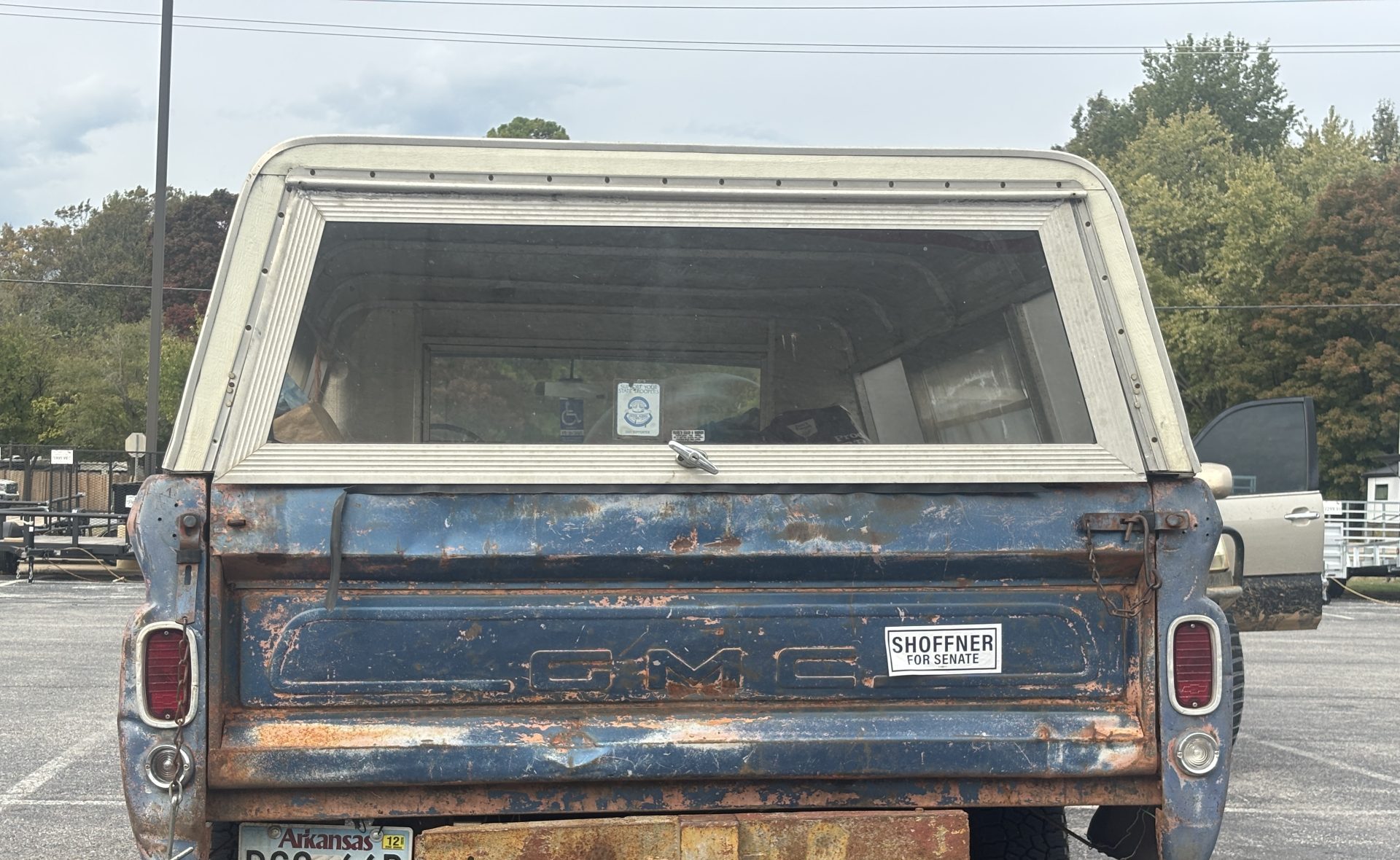
Western Arkansas is poultry country. From the Missouri state border all the way down to Grannis and De Queen, long strips of metal barns line the county roads. The farms emit a sickly-sweet aroma with a sour bite—an odor that suffuses the Ozark and Ouachita Mountains. As I drove down the poultry corridor to see upstart Democratic Senate candidate Hallie Shoffner on the campaign trail, this very distinctive smell of chicken shit hung in the air. On the way, I pulled off the highway in Fort Smith and waited in a line of cars at a Walmart, where gas was 16 cents cheaper than at the place down the road.
Arkansas is an ag state. In addition to poultry, farmers here grow commodity crops like rice, soybeans, and cotton—industries whose perpetual state of crisis has reached a fever pitch this year, partially due to Trump’s trade war with China, where a lot of Arkansas soybeans used to end up. Many commodity farmers will tell you that the federal aid and USDA dollars pumped into large farms go right back out to behemoths like Cargill and Bayer, pushing small farms deep into debt every year in order to buy basic inputs like seeds, fertilizer, and machinery. When they try to sell their products, it’s much the same: Farmers are locked into contracts with corporations like Tyson or forced to sell to multinational grain companies at pretty much any price, however low. There’s no other way to access the market. Farmer suicides are up, farms are closing, and debt is skyrocketing. Farm bankruptcies doubled in 2025—the second year in a row Arkansas has led the country in that statistic.
As Shoffner tells it, it was this crisis that launched her into a senatorial bid last July. Shoffner is a 39-year-old, sixth-generation soybean farmer from Newport, in the state’s eastern Delta—or she was, until she had to shutter her family’s farm in 2025. Shortly after, she started writing about agricultural policy and farm closures, including her own, on Substack. She was invited to appear at a town hall in Little Rock—while her future opponent was at a $7,000-a-plate fundraiser down the road—to discuss the farm crisis. After that, people started asking her to run. She said yes. “If I can’t farm, I’ll fight,” she says at her rallies. Shoffner’s emphasis on farms and farmers is what brought me to her town hall on the campus of Southern Arkansas University, in the quiet town of Magnolia.
The other reason I went was a poll, conducted by Hendrix College in August, that showed Shoffner with a three-point lead over current senator Tom Cotton—a surprisingly tight race for a well-funded two-term incumbent who’s never faced a serious challenger. The poll scared Cotton’s people enough that the campaign and its allies have pumped more than $13 million into the race, most of it spent on attack ads that show Shoffner saying she’d vote to defund ICE, or, in a misleadingly edited clip, that she’d “trade five Americans” for an undocumented farm worker.
For the last few election cycles, it’s been easy to ignore Democratic politics in Arkansas. As late as 2012, the state was a bastion of blue in an otherwise Republican South, but that year, the state legislature flipped Republican for the first time since Reconstruction. Today Arkansas’s Democratic party is in shambles, as the GOP has captured congressional seats and won supermajorities in both state legislative houses. During the 2020 Senate race, Arkansas Democrats failed to even nominate an opponent to run against Cotton. (The milquetoast candidate they did initially put up had to withdraw before campaigning even started, after state Republicans threatened to file an FEC complaint over alleged irregularities in his campaign filings.)
The first elections I voted in were the 2014 midterms, when Cotton won a double-digit victory against two-term Democratic incumbent Mark Pryor. I had recently moved north for college, and with Cotton’s victory, it felt like the state where I grew up had conceded to the worst image of itself, embracing the conservatism my classmates imagined was rampant outside of big cities. Cotton’s campaign lambasted Pryor as a proxy for Obama’s healthcare and tax policies, a symbol of the liberal elite whom the Harvard-educated Cotton has claimed to repudiate ever since.
Cotton’s style presaged what was to come in 2016: a reactionary conservatism born of the Tea Party, Koch-funded, vengeful, destructive. As in the rest of the country, Republicans in Arkansas have been remade in Trump’s image. The centrist former governor Asa Hutchinson, who left office in 2023, was the last of the state GOP’s non-MAGA politicians. He was succeeded by nepo baby and former Trump press secretary and Sarah Huckabee Sanders, whose dad, Mike Huckabee, is another former Arkansas governor-turned-Fox News host and, now, ambassador to Israel.
Cotton is cut from the same cloth: He loves war, he hates China, and he’s mostly in lockstep with Trump (although the two disagree so vehemently about Daylight Savings Time that the president recently posted Cotton’s personal cell phone number to Truth Social in a fit of anger). As chair of the Senate Intelligence Committee, Cotton is among the biggest supporters of the Iran War; even his domestic priorities tend to promote the war economy and center on defense against “Communist China.” Notoriously, at the height of the George Floyd uprisings in 2020, Cotton wrote an op-ed in the New York Times calling for federal troops to be deployed against protestors.
But for all intents and purposes, Cotton seems uninterested in Arkansas. Nearly a decade ago, he was jeered out of two in-state town halls with such force that he has never held another. Having so far run without a serious challenger, and with relatively few public appearances, it’s hard to tell whether Arkansas voters love Cotton, hate him, or land somewhere in between.
In a state where Trump’s approval ratings have shrunk to a relatively dismal 44 percent, Shoffner is trying to do to Cotton what the latter did to Pryor twelve years ago: capitalize on an unpopular president in a midterm election to flip a Senate seat. She’s been campaigning for more than a year across the state, and that diligent ground game is probably why, on my drive to Magnolia, I saw a wave of Shoffner signs on the rural roads through the Ouachitas. I don’t think I saw a single sign for Cotton, even in yards pocked with placards for other Republican candidates—and in at least one of those lawns stood a deep blue sign reading Hallie Shoffner U.S. Senate. Still, the Democratic brand remains toxic to many Arkansas voters, and Shoffner is running as an independent in all but name. One of her ads features a soybean farmer who regrets his previous support for Cotton. Shoffner regularly tells voters that if elected, the letters that will matter most at the end of her name are AR: Arkansas.
As I pulled onto the SAU campus on October 5, a tractor crossed in front of me, with one haybale forked on the front and a second loaded on the back, making its way across the main thoroughfare. A few hundred feet down the road, I saw Shoffner walking toward the campus’s community center, where a few dozen students were gathered for a stump speech and question-and-answer session. Many of these students grew up here, or close by. One of them asked Shoffner about rising health insurance costs; another asked about the LEARNS Act, a 2023 state law implementing a school voucher system that threatens the already precarious finances of rural school districts, like those around Magnolia. Shoffner fielded these questions deftly and attentively; she was obviously well prepared, but also seemed genuinely interested in the conversation.
The evening’s main event, though, was a “Rally for Hallie” at SAU’s Agriculture Building. The lecture hall filled up fast: families with kids, faculty, people who had driven in from several towns over. A few minutes before the rally began, a group of students walked in, clearly farm kids—trucker hats, tattooed arms. One wore that specific combination of tight Miss Me jeans, tucked-in T-shirt, and braids that signals “country girl.” They were all in the same Agricultural Policy class, and they had questions about particular sections of the Farm Bill.
The federal Farm Bill is economic, agricultural, and social policy all rolled into one mammoth legislation. Traditionally renegotiated every five years, it combines SNAP funding with allocations for USDA programs, a handshake deal meant to protect both farm interests and welfare. But the last time Congress passed the bill was in 2018; the current renegotiation has been stalled since 2023 amid partisan deadlock. This year Republicans, including Cotton, psuhed to decouple food assistance from farm policy by moving SNAP funding—which faces $200 billion in cuts over ten years—into the One Big Beautiful Bill; hundreds of thousands of people stand to lose their benefits as a result. Meanwhile, the Farm Bill itself has been left out to dry. Cotton voted against the most recent version, which he insisted included too much money for SNAP. Shoffner explained that though she disagrees with a lot of the bill’s current structure, she’d have voted for it, to ensure economic security for farmers and food security for low-income families.
“The system is rigged against us,” Shoffner said, launching into her speech in a blunt, Bernie-esque cadence. “We are suffering, and Tom Cotton is taking our suffering to the bank. He’s cashing in on our distress.” Cotton’s absence on the campaign trail has been a ready target for Shoffner’s jabs. Compared to the tall, glowering Cotton, she’s approachable, more concerned about bread-and-butter issues than about containing Beijing. Her message speaks to the nexus of debt, unaffordability, and dim economic prospects that have beleaguered so many in the state. Cotton’s campaign, meanwhile, has played the standard MAGA tune: immigration crackdowns, higher defense spending, law and order, lower taxes. He also claims the farm crisis is a problem of excessive imports, subsidized by foreign governments. Shoffner’s farm fix starts closer to home. At SAU, she raged against Big Ag and federal subsidies, pushing for smaller, more diversified farms and sustainable local economies: Imagine Wendell Berry, if he was a commodity farmer.
One of the Ag Policy students asked Shoffner about Section 1001 in the Farm Bill, which has to do with price supports and commodity programs, also siphoned by congressional Republicans into the One Big Beautiful Bill. Shoffner said she’d prefer to see those returned back to Farm Bill legislation, adding that support for commodity crops—like soybeans and corn—are part of the reason the Bill itself is a “corporate bailout” that incentivize farming for international markets at the expense of farms with diverse crops, like bell peppers and sweet potatoes, that could be consumed locally. Instead, Shoffner wants to restructure the Farm Bill to encourage production of diversified crops would require local processing centers, which, she says, would provide jobs in farming towns, in turn revitalizing rural economies. These proposals go against the last sixty years of economic development policy in Arkansas, which has sought to lure manufacturing and high-tech industries; such projects take a long time and a lot of government aid, and after more than half a century, their benefits have yet to materialize for many of Shoffner’s potential constituents. It’s a bit of a utopic vision, to put it mildly, but it offers something new to people for whom the status quo hasn’t worked for a long time.
The questions at the rally weren’t just about farm policy. A student sitting next to me asked Shoffner about her views on Israel. She doesn’t have a problem with Israelis, she answered, but she does have a problem with Netanyahu, and with all the attention Cotton seems to pay to Israel. (Cotton has received $1.4 million in campaign contributions from pro-Israel PACs.) A young person with a septum piercing asked about data centers; Shoffner, dodging the question a bit, said she’s for transparency and local control. She’s also against school vouchers, another departure from Cotton. She’s skeptical of the industries—defense manufacturers like Lockheed Martin and Raytheon, and a new lithium mine—that Cotton and Huckabee Sanders have brought to the state. On most meat-and-potatoes issues, like education and healthcare, her stances were clear and assured.
The lecture hall was standing-room only, with about a hundred people out on a Monday night in what is, on paper, a deeply conservative county. A campaign staffer told me Shoffner was getting this kind of reception everywhere she went. The next week, a few hundred supporters showed up to a rally in another college town, Fayetteville, one of the state’s more liberal enclaves. Another rally was to be held in Bentonville, where Walmart has its corporate headquarters. The campaign is hopeful: With her populist, retail-politicking campaign, Shoffner has turned out to be the kind of candidate that could shake things up.
Yet the latest polls show Shoffner down by nine points—a sign that Cotton’s ad blitz may be working. My bet is Shoffner won’t win this election. Even if she does, there’s not much a single first-term senator could do to fix the Farm Bill, let alone the USDA or the rural economy, whose complexities have bedeviled generations of bureaucrats and politicians alike. But as I watched Shoffner talk to a long line of college students, moms with their children, elderly couples, and teenagers in a place that’s long been inhospitable to progressive politics, it was clear she’d already succeeded in redefining what a Democratic campaign could look like.


